
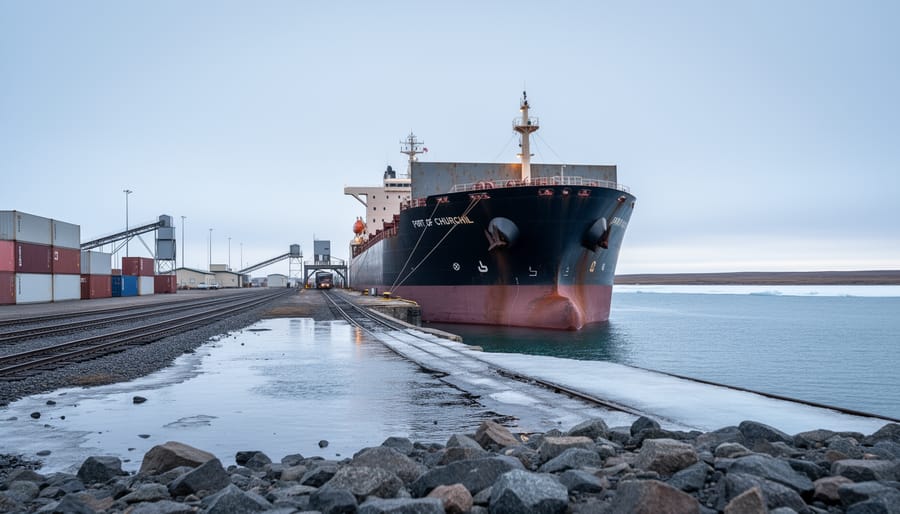
What Is the Port of Churchill (and How Did It Shape the North)?

The Port of Churchill is Canada’s only Arctic deepwater seaport, located on the western shore of Hudson Bay in northern Manitoba, serving as a vital shipping gateway between North America’s interior and global markets via Arctic sea routes.
For more than a century, this remote harbor has been a cornerstone of Churchill’s identity and survival. It connects prairie grain farmers to international buyers, anchors the town’s economy, and stands as one of the most ambitious infrastructure projects ever undertaken in Canada’s North. When functional, the port ships hundreds of thousands of tonnes of grain to Europe, Africa, and beyond each shipping season. When idle, as it was from 2016 to 2019, the town’s population dwindled and local businesses struggled to survive.
Understanding the Port of Churchill means grasping how geography, economics, and community resilience converge in one of the most isolated settlements on the continent. The port operates only during the brief ice-free season from late July through early November, yet its presence shapes year-round life in Churchill. It employs locals directly and indirectly, fuels regional development, and represents a tangible link between the town and the wider world.
This article explores how the port functions within extreme Arctic conditions, traces its evolution from Hudson’s Bay Company fur-trading outpost to modern bulk shipping facility, and examines its profound impact on the people who call Churchill home. The story of this port is inseparable from the story of the community itself.
What the Port of Churchill Means to Canada’s North
The Port of Churchill sits at 58 degrees north latitude on the western shore of Hudson Bay, making it Canada’s only deepwater Arctic port with direct ocean access. This remote facility serves as the northern terminus of a 1,000-mile rail line stretching from central Canada, creating a vital corridor that connects prairie grain fields to international shipping lanes through some of the planet’s most challenging waters.
The port’s strategic value lies in its position as the shortest shipping route between prairie farmers and European markets. Grain loaded onto ships in Churchill can reach ports in Northern Europe roughly 1,000 nautical miles closer than the same cargo shipped through Thunder Bay and the St. Lawrence Seaway. That distance advantage translates into fuel savings, reduced shipping times, and competitive pricing for Canadian agricultural exports when ice conditions permit navigation.
- Arctic deep-water port
- A harbor facility capable of accommodating large oceangoing vessels in sub-Arctic or Arctic waters, typically requiring specialized ice management and seasonal operations.
- Hudson Bay Railway connection
- The 510-mile rail line linking Churchill to Thompson and southern Manitoba, serving as the only ground transportation route for moving bulk goods to the port.
- Grain export terminal
- The port’s primary infrastructure for receiving, storing, and loading wheat, canola, and other agricultural products onto ships bound for international markets.
- Northern supply chain
- The network of transportation routes and logistics systems serving remote Arctic and sub-Arctic communities, often dependent on seasonal access and specialized infrastructure.
Beyond grain shipments, the port functions as a critical resupply point for Nunavut communities and northern Manitoba. Bulk fuel, construction materials, and essential goods arrive by ship during the brief ice-free season, then travel onward to settlements across Canada’s North. Without this facility, those supplies would face prohibitively expensive air freight or impossibly long overland hauls.
The port also anchors Churchill’s economic identity. For a town of roughly 900 people in one of Canada’s most isolated regions, the facility represents jobs, connection to southern markets, and proof that northern communities can sustain industrial-scale operations despite geographic challenges. It’s infrastructure, yes, but it’s also a statement about what’s possible at the edge of the Arctic.
How the Port of Churchill Works
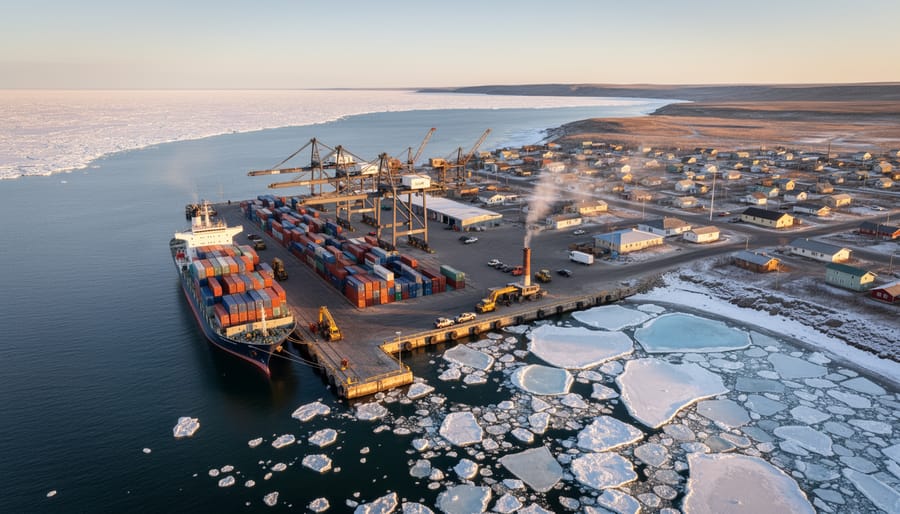
The Port of Churchill operates as a carefully choreographed seasonal ballet, where timing, weather, and logistics must align perfectly. The process begins roughly 1,000 miles south, where prairie farmers harvest wheat, canola, and barley across Manitoba and Saskatchewan. These grains travel north via the Hudson Bay Railway, a 621-mile line that’s the port’s lifeline, arriving in hopper cars that wind through boreal forest and tundra before reaching Churchill’s terminal.
Once trains arrive at the port, grain gets transferred into massive storage facilities with a combined capacity of around 90,000 tonnes. The terminal’s elevator system moves grain from railcars through a network of conveyors and distributors, cleaning and sorting it before storage. When vessels arrive, the loading process uses shiploader equipment that can transfer grain directly into holds at rates of several hundred tonnes per hour, depending on the ship size and cargo type.
The port’s operational calendar revolves entirely around Hudson Bay’s ice conditions. The shipping season typically runs from late July through early November, just three to four months when the bay is navigable. Ice begins forming in November and doesn’t fully break up until mid-summer, creating a tight window that demands precision. Ship captains must navigate carefully through Hudson Strait, often with Canadian Coast Guard icebreaker support during shoulder seasons, making the route possible but weather-dependent.
What makes Churchill strategically valuable is geography. Shipping grain from Churchill to European or international markets cuts significant distance compared to routing through Thunder Bay and the St. Lawrence Seaway. For prairie farmers in northern Saskatchewan and Manitoba, Churchill represents the closest saltwater port, a straight shot north rather than east through the Great Lakes bottleneck.
The port handles more than just grain. General cargo arrives on return voyages, construction materials, fuel, vehicles, and supplies destined for northern communities across Nunavut and the western Arctic. These goods get unloaded and stored in warehouses before redistribution, making Churchill a two-way hub rather than just an export terminal.
Infrastructure includes the grain terminal itself, deep-water berths capable of handling Panamax-class vessels, marine service facilities, and storage warehouses. The port can accommodate multiple ships simultaneously, though single-vessel loading is more common given the condensed season. Everything must function flawlessly during those precious ice-free months, because there’s no margin for extended delays or equipment failures when winter is approaching.
The Historical Journey of Churchill’s Port
Early Maritime Trade and Indigenous Roots
Long before European ships appeared on Hudson Bay’s horizon, Indigenous peoples understood what made Churchill’s shoreline special. The Dené, Inuit, and Cree nations traveled these waters for generations, recognizing the river mouth as a natural meeting point where freshwater met tidal currents. The estuary’s deep waters and protected position from prevailing winds created a rare safe harbor along hundreds of miles of shallow, storm-battered coastline.
When Hudson’s Bay Company explorers arrived in the late 1600s, they quickly grasped what Indigenous traders already knew: this was one of the few places where ocean-going vessels could approach close to shore without grounding. Early fur trading posts sprang up precisely because the geography allowed ships to anchor safely and transfer cargo efficiently. The Churchill River provided a natural highway inland, while the bay offered direct access to European markets, a combination that would eventually make this spot Canada’s Arctic gateway. These advantages weren’t engineered or built; the land itself had shaped an ideal harbor waiting to be used.
Building Canada’s Gateway to the Arctic
The federal government broke ground on the Port of Churchill in 1929, driven by a bold vision: create a direct shipping route from Canada’s grain-rich prairies to European markets. The location made strategic sense, Churchill sat 1,000 miles closer to Liverpool than traditional routes through Vancouver or the Great Lakes, potentially shaving weeks off delivery times and cutting transportation costs for western farmers.
Construction crews faced brutal Arctic conditions. Workers battled permafrost, mosquitoes, and temperatures that plunged to minus 40. Engineers had to design specialized docks and grain elevators that could withstand ice pressure and ground movement from seasonal freezing. The railway line connecting Churchill to southern Manitoba required constant reinforcement across boggy muskeg terrain.
The port officially opened in 1931, though its first full shipping season didn’t begin until 1932. That inaugural year saw modest success, three ships carried prairie wheat to Europe through Hudson Bay’s ice-free summer window. The vision promised prosperity: faster grain exports, reduced shipping bottlenecks, and economic development for Canada’s isolated north. Local residents watched with cautious optimism as their remote settlement transformed into a strategic gateway linking prairie agriculture to Atlantic markets.
Decades of Growth and Challenge
From the 1950s through the early 2000s, the Port of Churchill rode waves of prosperity and weathered storms of uncertainty. The port’s peak years came in the 1960s and 1970s when massive grain shipments flowed north by rail, then sailed to Europe and beyond. In 1978 alone, over 600,000 tonnes of wheat passed through Churchill’s facilities, a record that symbolized the port’s importance to prairie farmers seeking shorter routes to overseas markets.
But nothing stays golden forever. Global grain prices fluctuated wildly. The Soviet Union, once a major wheat buyer, collapsed. Shipping companies questioned whether the shorter Hudson Bay route truly saved money when balanced against insurance costs and the narrow window before ice returned. By the 1990s, annual tonnage had dropped significantly.
Infrastructure aged without matching investment. Rails needed repairs. Loading equipment grew outdated. The port changed hands multiple times as owners struggled to make operations profitable. Then came the devastating blow: in July 2016, OmniTRAX abruptly closed the port and stopped maintaining the rail line after a spring flood damaged tracks. Churchill was suddenly cut off, its lifeline severed. The town held its breath, wondering if its port would ever ship grain again.
Revival and Modern Era
When Denver-based AGT Food and Ingredients, along with Mexico’s Fairfax Financial Holdings and the Missinippi Rail consortium, purchased the port in August 2018 for $20 million, Churchill residents celebrated in the streets. The new owners committed $117 million to restore the rail line and port facilities that had deteriorated during two years of abandonment. By October 2018, the first grain shipment in over two years departed Churchill, carrying 30,000 tonnes of wheat to Thailand. The revival signaled more than resumed operations, it represented restored dignity and economic hope for a community that had refused to let its lifeline die.
Types of Operations and Cargo at the Port
The Port of Churchill handles a remarkably diverse mix of cargo that reflects both the agricultural heartland of the Canadian Prairies and the unique needs of Canada’s remote northern communities. This dual role makes it unlike any other port in the country.
Agricultural Exports: The Port’s Traditional Backbone
Grain shipments have always been the port’s bread and butter. Prairie farmers send wheat, canola, and barley north by rail to Churchill, where bulk carriers load the crops for international markets. The Churchill route can reduce shipping distances to European and some Asian markets compared to West Coast ports, though grain pricing remains sensitive to freight rates, ice season timing, and global market conditions. When operational, the port typically moves hundreds of thousands of metric tonnes during the brief summer shipping window.
Northern Resupply: Lifeline Cargo
The port also serves as a critical import hub for goods destined for communities across Nunavut and northern Manitoba. The cargo categories include:
- Agricultural grains for export (wheat, canola, barley)
- Construction materials (lumber, concrete, steel) for building projects
- Fuel supplies (diesel, gasoline) for heating and power generation
- Mining equipment and heavy machinery for resource development
- Consumer goods for northern resupply (food, household items, retail inventory)
These shipments arrive during the ice-free months and get distributed to isolated communities where year-round road access doesn’t exist. A single cargo vessel can deliver supplies that would otherwise require dozens of costly airlift operations.
Emerging Opportunities: Minerals and Arctic Development
The port’s potential extends beyond grain and general cargo. Northern Manitoba holds significant mineral deposits, and Churchill could become an export gateway for mining operations if transportation infrastructure improves. Nickel, copper, and lithium projects in the region eye the port as a viable shipping alternative.
Arctic shipping opportunities are also growing. As climate change extends the ice-free season, Churchill’s position on Hudson Bay could attract more container traffic, research vessels supporting Arctic science, and even cruise ships seeking authentic northern experiences. The port’s versatility, switching between bulk grain, break-bulk cargo, and containerized goods, positions it to adapt as northern economic priorities shift.

How the Port Is Used Today and Its Future Potential
Today, the Port of Churchill handles grain exports as its primary business, wheat, canola, and barley flow north by rail from prairie farms, then ship overseas during the ice-free season, typically late July through early November. This route offers prairie producers a shorter path to European and Asian markets compared to moving grain west to Vancouver, shaving thousands of kilometers off the journey and reducing transportation costs. Beyond grain, the port serves as a critical resupply point for northern communities across Nunavut and the eastern Arctic, bringing in construction materials, fuel, vehicles, and other goods that would otherwise cost significantly more to fly in. Research vessels also use Churchill’s facilities as a staging base for Arctic scientific missions, taking advantage of the port’s infrastructure and protected harbor.
When is the Port of Churchill actually open for shipping?
The port operates during the ice-free season, generally from late July through early November, with exact dates varying based on Hudson Bay ice conditions each year.
What makes Churchill’s shipping route advantageous compared to other ports?
Churchill provides prairie farmers a shorter route to overseas markets, particularly Europe, cutting roughly 1,000 kilometers off the distance compared to shipping through Vancouver or Thunder Bay.
How is climate change affecting port operations?
Warming temperatures are extending the ice-free season in Hudson Bay, potentially allowing longer operating windows and opening new Arctic shipping routes that could increase Churchill’s strategic importance.
Can tourists visit the Port of Churchill?
The port itself is an active industrial facility with restricted access, but visitors can view it from public areas and learn about its history through interpretive resources in town.
The port’s future potential extends well beyond its current operations. Climate change, despite its broader environmental challenges, is paradoxically opening opportunities for Arctic shipping as ice retreats and the Northwest Passage becomes more navigable. Churchill sits perfectly positioned to serve as a hub for this emerging traffic, potentially handling cargo transfers, ship resupply, and becoming a key waypoint for vessels traveling between Asia and Europe via Arctic routes. The federal government has recognized this strategic value, Arctic sovereignty depends partly on demonstrating active Canadian presence in northern waters, and a functioning port at Churchill strengthens that claim.
Economic development prospects include mineral exports from Nunavut mines, which currently face extreme transportation costs. If ore could be shipped through Churchill rather than flown south, mining operations become more viable, creating jobs both at extraction sites and at the port. There’s also discussion of passenger vessel services, cruise ships exploring Arctic waters could use Churchill as a starting point, linking tourism dollars to port activity. None of this is guaranteed, of course. The port needs continued investment in infrastructure, rail line reliability remains a concern after past washouts, and global shipping patterns shift unpredictably. But the bones are there: deep water, rail connection, and a community that has proven it won’t let its port die quietly. For Churchill, the port represents not just economic activity but possibility itself, proof that the North can adapt, compete, and build a future on its own terms.
Community Impact: Churchill’s Lifeline

For Churchill’s 900 residents, the port isn’t just infrastructure, it’s the thread that holds the community together. When the facility shut down in 2016, the town didn’t simply lose jobs. It lost its economic anchor, its connection to the south, and a piece of its identity that had defined life here for nearly 90 years.
The closure hit hard and fast. Fifty direct jobs vanished overnight, taking with them the skilled labor that had kept families rooted in this remote corner of Manitoba. Port workers, engineers, crane operators, rail handlers, faced an impossible choice: uproot their lives and move south, or stay in a town with dramatically fewer opportunities. Many left. Schools felt the impact as enrollment dropped. Local businesses watched their customer base shrink. The psychological toll was just as real as the economic one.
Churchill had always been a place where people chose to stay despite the challenges. Groceries cost more here. Winter temperatures plunge to minus 40. You can’t drive out, the nearest road connection is hundreds of kilometers away, so residents get to Churchill by train or plane, a reality that makes the port’s connection to southern markets even more vital. When the port closed, it felt like the last link had been severed.
The reopening in 2018 brought more than renewed grain shipments. It brought hope back to a community that had been holding its breath. Jobs returned. Families who’d been considering leaving decided to stay. Young people saw a future here again. The port’s revival signaled something deeper: Churchill wasn’t abandoned, and the resilience that has always defined this town had proven itself once more.
Today, the port employs around 40 people directly during shipping season, with additional seasonal work that ripples through the local economy. These aren’t just paychecks, they’re careers that allow people to build lives in a place they love. Port workers spend their earnings at local shops, eat at town restaurants, and invest in their community. The multiplier effect sustains other businesses and strengthens Churchill’s economic foundation.
But the port’s value goes beyond dollars. It’s a symbol of Churchill’s unique place in Canada’s north, a town that matters, that contributes, that connects prairie farmers to global markets through Arctic waters. When visitors come for polar bear country or beluga whale watching many don’t realize the industrial port sitting alongside those natural wonders is just as essential to understanding Churchill’s story.
Travelers planning their trips, checking visiting tips or researching where to stay are experiencing a community that survived because it refused to let go of what made it vital. The port’s survival is Churchill’s survival, and that determination shapes everything about this remarkable northern town.
Visiting the Port: What Travelers Should Know
The Port of Churchill isn’t a traditional tourist attraction with guided tours or visitor centers, but travelers curious about its history and operations can still experience it meaningfully during a Churchill visit.
You can view the port facilities from several vantage points around town. The grain elevators, massive concrete structures visible from miles away, dominate Churchill’s skyline and serve as excellent photo subjects, especially at sunrise or sunset when the light hits them dramatically. Walk or drive along the waterfront roads for closer views of the terminal buildings, railway infrastructure, and docked vessels during the brief shipping season from late July through October.
Churchill’s Town Complex Museum, located in a restored 1950s building, offers historical context through exhibits on the port’s construction, operational history, and community impact. Photographs from the building era and artifacts from decades of shipping operations help visitors understand what the port meant to Churchill’s economy and identity. The museum staff can answer questions about current operations and point you toward the best viewing spots.
Respect safety boundaries around the port area. This is an active industrial facility with heavy equipment, moving trains, and restricted zones. Never enter fenced areas or climb on structures. Photography from public roads is acceptable, but drone use typically requires permission from port authorities.
The port experience complements Churchill’s wildlife tourism perfectly. Many visitors arrive for polar bears in fall or beluga whales in summer and discover the port’s story adds unexpected depth to their trip. It represents the human side of Churchill, how people have built lives and livelihoods in this remote corner of Canada.
Local tour operators sometimes incorporate port history into town tours, offering commentary as you pass the facilities. Ask your guide about the 2016 closure and 2018 reopening; many Churchill residents have personal connections to the port and share compelling stories about what it means to their community.
The Port of Churchill stands as living proof that infrastructure can carry the weight of an entire community’s hopes. It’s not just a collection of grain terminals and shipping docks on Hudson Bay, it’s the beating heart of a town that refused to give up when the world seemed ready to let it fade away.
When you visit Churchill, you’ll come for the polar bears and beluga whales. You’ll marvel at the northern lights and the tundra’s stark beauty. But take a moment to look across the harbor at those grain elevators and railway tracks. They represent something profound: a community that weathered abandonment and emerged stronger, a strategic gateway that proved its worth when doubters said it had none.
The port’s story is Churchill’s story, resilience forged in isolation, prosperity built against the odds, and a future that remains unwritten but decidedly promising. Every ship that passes through those waters carries more than cargo. It carries the determination of farmers, the ambitions of a nation looking north, and the pride of a community that knows what it means to be essential.
That understanding makes Churchill more than a destination. It makes it unforgettable.
